




2026 Mazda CX-70 vs. CX-90
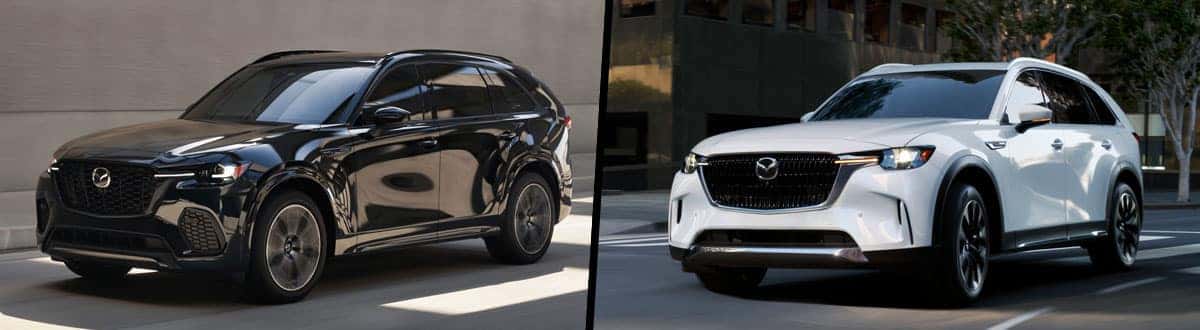
2026 Mazda CX-70 vs. CX-90: Which SUV Fits Your Family?
If you’ve been cross-shopping Mazda’s larger SUVs, you’ve probably noticed the CX-70 and CX-90 look — and drive — remarkably alike. That’s by design. At Caruso Mazda of Long Beach, we help shoppers from Long Beach, Lakewood, and Seal Beach work through this exact decision every month.
It almost always comes down to one question: how many seats do you actually need? Both SUVs share Mazda’s inline-6 performance platform and premium interior appointments, so the choice is less about compromise and more about which layout matches your life.
The Core Difference: Seating
The CX-70 is a two-row SUV seating five, built for drivers or couples who want more dedicated cargo space rather than a third row they’ll rarely use. The CX-90 adds that third row, seating up to eight depending on configuration, making it the pick for larger families, carpool duty, or anyone who regularly hosts extra passengers.
Despite the different layouts, both SUVs share a passenger volume of 141.6 cubic feet — the CX-90 isn’t “bigger,” it’s just organized differently.
Shared Power, Shared Confidence
Both models are available with the same 3.3-liter e-SKYACTIV G turbocharged inline-6 engine with 48V Mild Hybrid Boost. The standard configuration produces up to 280 horsepower, while the available Turbo S version steps up to 340 horsepower, paired in both cases with an 8-speed automatic transmission and standard rear-biased i-Activ AWD.
That means choosing between the CX-70 and CX-90 doesn’t mean choosing between power levels — you get the same driving character either way, with the CX-70 offering a slightly quicker step-off thanks to its lighter curb weight. For drivers interested in electrification, both the CX-70 and CX-90 are also offered as plug-in hybrids, pairing a 2.5-liter e-SKYACTIV PHEV four-cylinder with an electric motor for meaningful EV-only range on top of full hybrid capability — ideal for SoCal commuters who want to minimize gas station visits between Torrance and Huntington Beach.
Towing and Cargo
Properly equipped, both the CX-70 and CX-90 can tow up to 5,000 pounds with their gas-powered inline-6 engines, giving either one real capability for a small trailer, boat, or off-road toys.
On the cargo side, the CX-70’s two-row layout gives it up to 75.3 cubic feet of total cargo space, while the CX-90 trades some of that for third-row flexibility.
Where They Might Differ by Trim
Because the CX-90 sits at the top of Mazda’s SUV lineup, some equipment that comes standard on the CX-90 may require an upgraded trim level to get on the CX-70 — this can include items like a heads-up display or built-in navigation.
We’d recommend confirming exact trim-level equipment with our team before assuming a feature isn’t available on either model, since Mazda frequently offers items as optional packages rather than leaving them off entirely.
Quick Comparison: CX-70 vs. CX-90
Frequently Asked Questions
Do the CX-70 and CX-90 have the same engine options?
Yes. Both offer the same 3.3-liter turbocharged inline-6 in standard (up to 280 hp) and Turbo S (up to 340 hp) configurations, plus PHEV options.
How many people can the CX-90 seat?
Depending on seating configuration — bench or captain’s chairs — the CX-90 can seat up to eight passengers across three rows.
Can the CX-70 tow as much as the CX-90?
Yes, both can tow up to 5,000 pounds when properly equipped with a tow hitch.
Is the CX-70 more efficient than the CX-90?
Both share very similar fuel economy given their shared powertrains; the CX-70’s slightly lighter weight can give it a small efficiency edge in some configurations.
See the CX-70 and CX-90 side-by-side at Caruso Mazda of Long Beach.
Whether you land on the two-row CX-70 or the family-ready CX-90, both deliver the same premium Mazda experience Southern California drivers have come to expect. Browse our current inventory to compare both models in person, or contact our team to schedule back-to-back test drives.
